
The Poet’s Blue is interior architect Anne Kosonen’s showroom home at Mariankatu 7 G 3 in the centre of Helsinki. The building was designed by G.T.P. Chiewitz and constructed in 1861 for its merchant owner Henrik Borgström (1799-1883) and his family. Its location, opposite the Ritarihuone, also designed by Chiewitz, and the nearby Presidential Palace and the Prime Minister’s Office, places the building in esteemed company. The apartment’s 2023 renovation was designed by Anne Kosonen in collaboration with Seven Days Studio, a thoughtful design platform where research and practical knowledge combine in solving design problems.
History
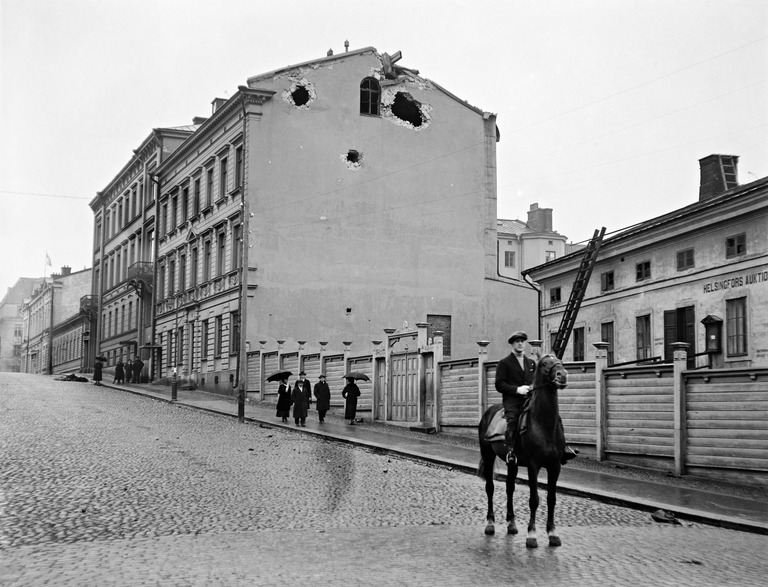
Mariankatu 7 is a protected building because of its important cultural value and its architectural significance as an example of early stone building construction. In the late 1820s young businessman Borgström purchased the site of Mariankatu 7 where he built a wooden apartment building designed by C.L. Engel. He also purchased the adjacent lot at Mariankatu 5 where he later built a stone commercial building.
Borgström was already an influential businessman and philanthropist when in 1858 fire damaged these buildings and he set about with the construction of the stone buildings currently on the two sites. Construction of Mariankatu 7 occurred at the same time as the Ritarihuone opposite which dominates the central park. (M. Lindqvist, 2021, http://www.hel.fi)
Borgström’s home was the centre of culture, with Finland’s ‘national poet’ J.L. Runeberg, author Zacharias Topelius and philosopher JV Snellman, among those significant contributors to Finnish culture and society who were regular visitors.
Today Mariankatu 7 remains as one of the oldest stone apartment buildings in Helsinki and currently houses private apartments as well as offices and design studios.
Designing the renovation
The design of the extensive renovation was born from three women’s different ways of approaching the design of spaces. Under consideration for this collaboration was first how the functional needs of a home would be accommodated in the space that would also be open to visiting clients, since its modest size of 87m2 meant that the public and the private spaces were to overlap. The next consideration was how to design a contemporary setting while maintaining the integrity of the historic, partially protected building.

It was important that the aesthetics were balanced between the old and the new, that the spirit of history was not driven away but supported by contemporary design. This was achieved by choosing simple lighting and reflective surfaces to harmonize with the space’s old structure. Italian designer Davide Groppi’s lighting was chosen to illuminate the apartment. The modest light fittings puncture the space with their geometry, allowing the illumination, the basic function of the light fitting, to be the focus.
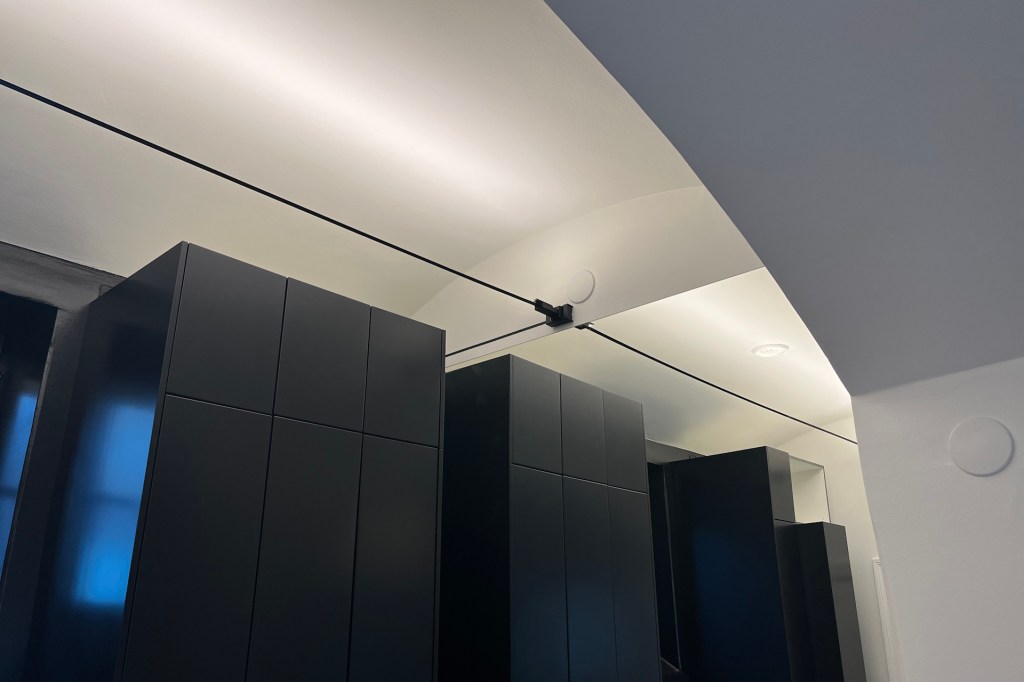
Each space within the apartment was finely detailed so that the experience of it would serve as its function. The entrance hall maintains the tradition of the threshold by inviting the visitor to quieten, before entering the apartment proper. The living showroom opens as an expanse of energetic white and the original spruce flooring was kept as-is as an echo of the footsteps of the people who have lived there before.
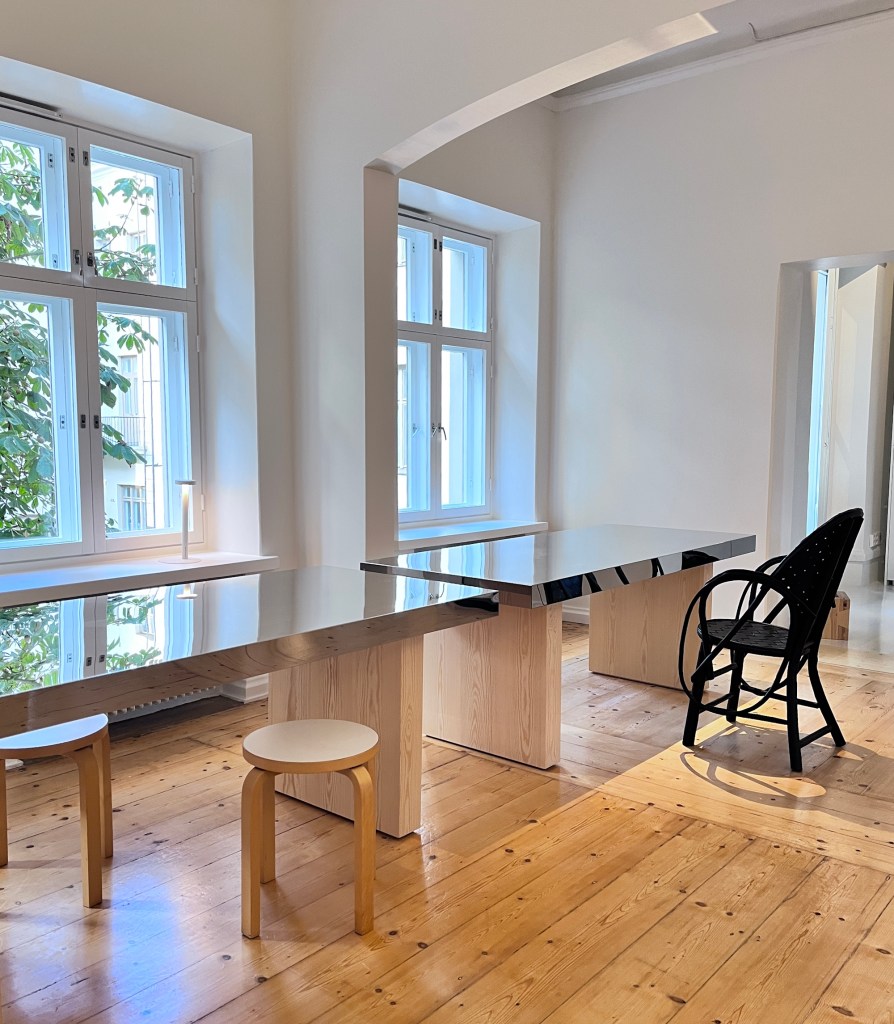
The all-white library is a quiet space where relaxation amongst treasured books provides relief from work routines. The kitchen is presented as a bistro catering to visiting clientele, with its functional areas of cooking and washing concealed behind screening doors. To combat the small area available to the kitchen, the reflective surfaces extend the visual space and the centre island protrudes as a welcome servery into the living space.
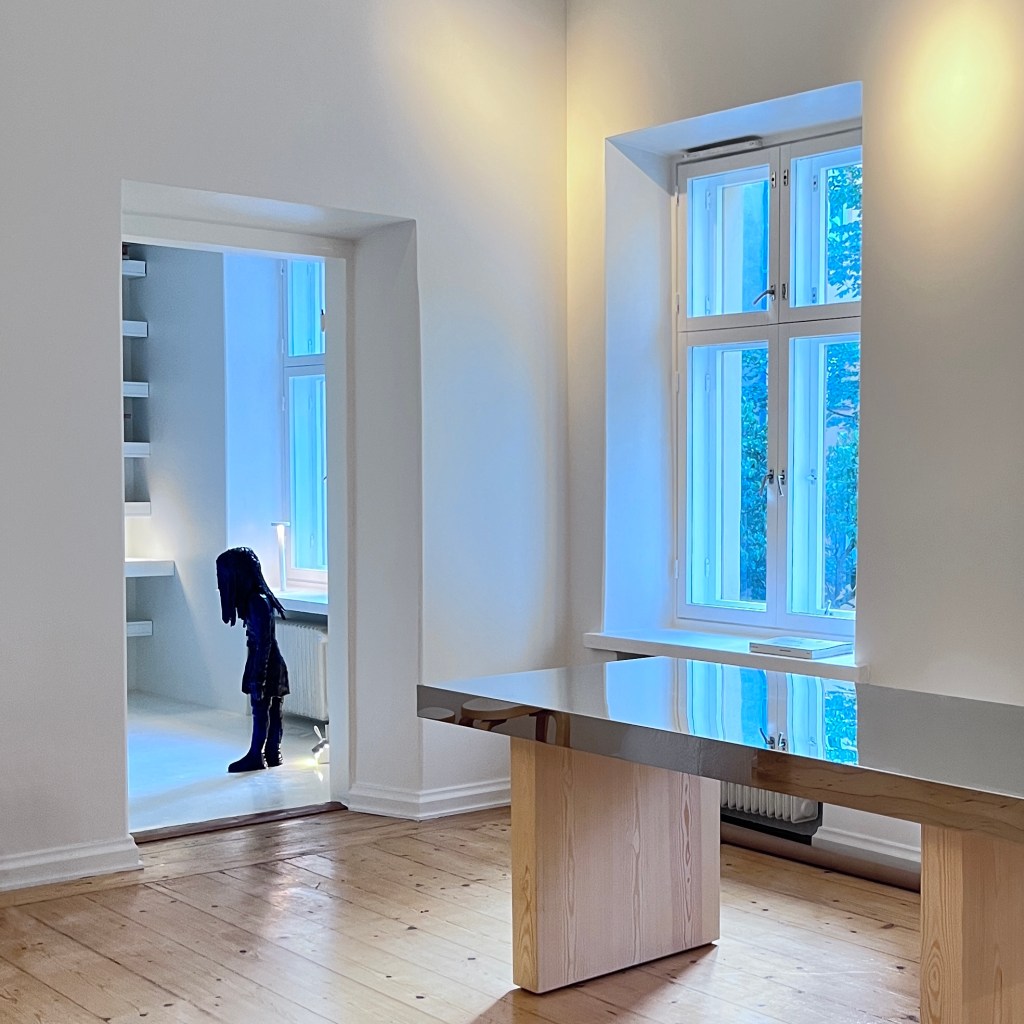
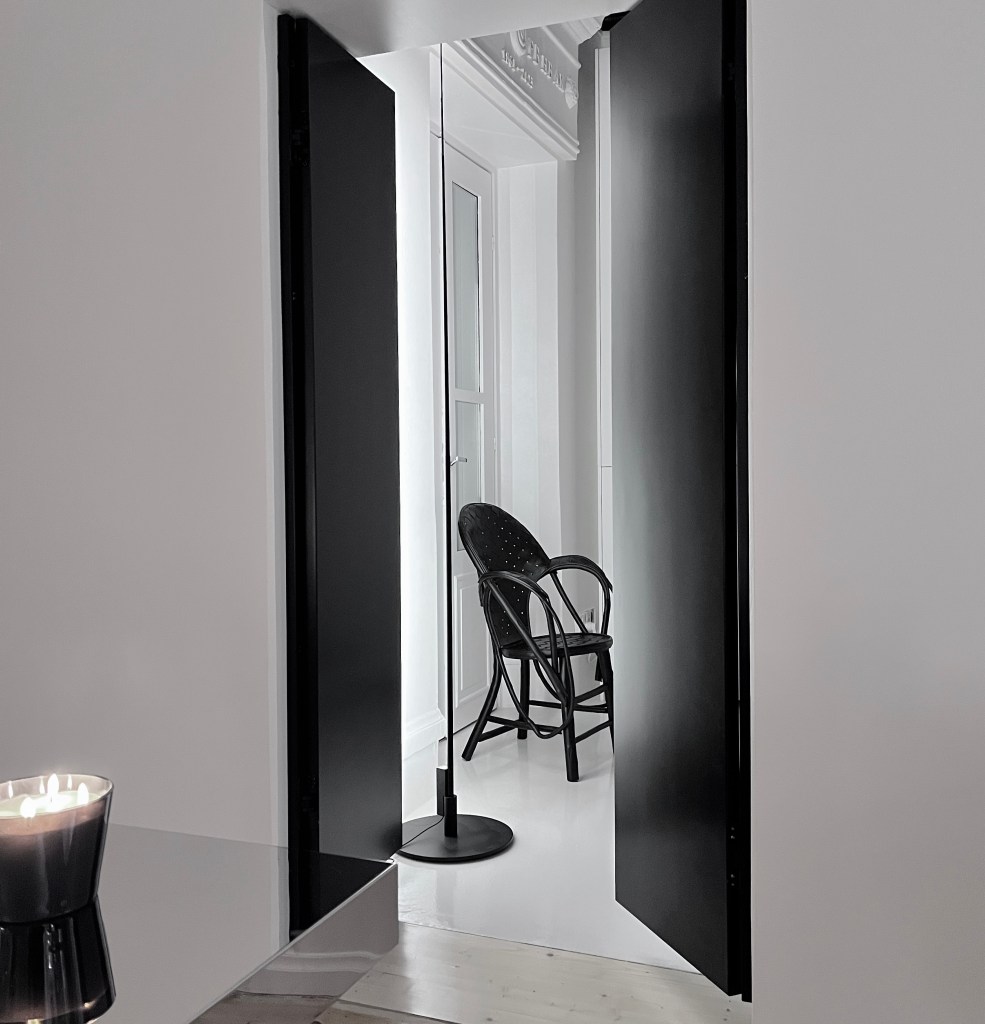
The bedroom is a quasi-private space that is hidden behind a pair of black saloon doors. Once these doors are open, the space provides access to the small balcony overlooking the building’s internal courtyard.
When floor space is at a premium, well-designed storage spaces are very important. The apartment’s storage spaces were designed by Seven Days Studio who approached the challenge by utilising the Seven Days Storage Solution process. This includes a co-design process and tool that assists the client in communicating their needs and for the designer to respond in designing the ultimate storage solution.

Image credits: Seven Days Studio unless otherwise noted.
 the poet's blue